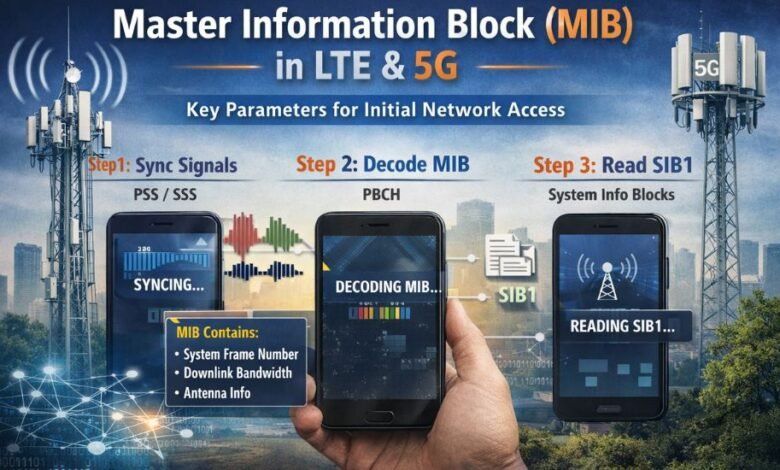
In modern cellular communication systems, everything begins with synchronization and basic system awareness. Before a smartphone can place a call, browse the internet, or connect to 5G data services, it must first understand the network it is attempting to access. The very first structured message that enables this understanding is called the Master Information Block (MIB).
The Master Information Block is one of the most fundamental building blocks in mobile communication systems such as LTE (4G) and 5G NR. It is broadcast continuously by the base station and contains the minimum essential information required for a User Equipment (UE) — such as a smartphone, IoT device, or modem — to begin communication with the network.
This article explores the Master Information Block in depth, covering its purpose, structure, role in LTE and 5G, technical composition, transmission mechanism, and importance in network access procedures.
What Is a Master Information Block?
The Master Information Block (MIB) is a small, fixed-format system information message broadcast by a cellular base station. It is transmitted over the Physical Broadcast Channel (PBCH) and provides essential parameters that allow a device to decode further system information.
In simple terms:
The MIB acts as the “entry pass” to a cellular network.
Without successfully decoding the MIB, a device cannot proceed to read other System Information Blocks (SIBs), which contain detailed configuration and operational parameters of the cell.
Why the Master Information Block Is Important
The importance of the MIB lies in its role during the initial cell search and acquisition process. When a device powers on or enters a new coverage area, it must:
- Detect available cells.
- Synchronize in time and frequency.
- Decode the Master Information Block.
- Use the MIB data to locate and decode additional system information.
If any of these steps fail — particularly MIB decoding — the device cannot attach to the network.
The MIB ensures:
- Basic network awareness
- Frame timing alignment
- Knowledge of bandwidth configuration
- Access to further broadcast system messages
It is always transmitted, regardless of whether any users are connected.
How the MIB Works in LTE (4G)
In LTE networks standardized by 3rd Generation Partnership Project (3GPP), the Master Information Block is transmitted on:
- Physical Broadcast Channel (PBCH)
- Mapped to the Broadcast Channel (BCH) at higher layers
LTE Cell Search Procedure
The LTE cell search process follows this sequence:
- UE detects Primary Synchronization Signal (PSS)
- UE detects Secondary Synchronization Signal (SSS)
- UE obtains cell identity and timing
- UE decodes PBCH to retrieve MIB
- UE reads System Information Block Type 1 (SIB1)
Without step 4 (MIB decoding), step 5 cannot occur.
Contents of the LTE Master Information Block
The LTE MIB contains a very limited number of critical parameters:
1. System Frame Number (SFN)
- Provides part of the 10-bit frame number
- Helps synchronize device timing with the cell
2. Downlink Bandwidth
- Indicates the number of Resource Blocks (RBs)
- Determines the width of the LTE channel
Possible values:
- 6 RB (1.4 MHz)
- 15 RB (3 MHz)
- 25 RB (5 MHz)
- 50 RB (10 MHz)
- 75 RB (15 MHz)
- 100 RB (20 MHz)
3. PHICH Configuration
- Hybrid ARQ indicator channel parameters
- Specifies duration and resource configuration
4. Transmit Antenna Configuration
- Number of antenna ports used by the base station
These few parameters are enough to allow the device to properly interpret the rest of the system information.
Transmission Characteristics in LTE
The LTE MIB has the following properties:
- Repeated every 40 milliseconds
- Mapped to specific subframes (subframe 0)
- Encoded using convolutional coding
- Scrambled with cell-specific identity
This repetition improves reliability, ensuring devices can decode it even in weak signal conditions.
Master Information Block in 5G N
With the introduction of 5G NR (New Radio), the concept of the Master Information Block remains, but its structure and transmission mechanism evolved.
5G NR was also standardized by 3rd Generation Partnership Project, ensuring continuity with LTE architecture while improving flexibility.
Key Differences Between LTE and 5G MIB
| Feature | LTE | 5G NR |
|---|---|---|
| Broadcast mechanism | PBCH in subframe 0 | PBCH within SS Block |
| Beamforming | Not beam-based | Beam-based transmission |
| Bandwidth indication | Direct RB value | Indirect via SIB1 |
| Coding | Convolutional | Polar coding |
5G NR MIB Transmission
In 5G NR:
- The MIB is transmitted as part of the Synchronization Signal Block (SSB).
- Each SSB contains:
- PSS
- SSS
- PBCH (which carries the MIB)
Unlike LTE, 5G uses beam sweeping. Multiple SSBs may be transmitted in different spatial directions, allowing devices to detect the best beam for connection.
This is crucial for:
- Millimeter wave (mmWave) frequencies
- Massive MIMO deployments
- Beamforming-based coverage
Contents of 5G NR MIB
The 5G MIB includes:
1. System Frame Number (partial bits)
Provides timing alignment.
2. Subcarrier Spacing
Indicates the SCS used for SSB.
3. DMRS Type A Position
Demodulation reference signal configuration.
4. PDCCH Configuration for SIB1
Indicates where SIB1 can be found.
5. Cell Barred Indicator
Indicates whether cell access is allowed.
6. Intra-frequency Reselection Indicator
Specifies whether cell reselection is permitted.
Compared to LTE, 5G shifts more configuration responsibility to SIB1, keeping MIB compact.
MIB vs SIB: What’s the Difference?
Many people confuse Master Information Block (MIB) with System Information Blocks (SIBs). The difference is fundamental.
| Feature | MIB | SIB |
|---|---|---|
| Size | Very small | Larger |
| Purpose | Basic access parameters | Detailed configuration |
| Transmission | Always periodic | Scheduled |
| Required first? | Yes | After MIB |
Think of the MIB as the “table of contents” and SIBs as the “chapters” of network configuration.
The Role of MIB in Network Entry
When a device attempts to connect:
- It scans frequency bands.
- Detects synchronization signals.
- Identifies cell ID.
- Decodes MIB.
- Locates SIB1 using information from MIB.
- Proceeds with Random Access Procedure.
Thus, the MIB is directly tied to:
- Initial Access
- Idle Mode Operation
- Cell Reselection
- Network Discovery
Without the Master Information Block, the network remains unusable.
Error Protection and Reliability
Because the MIB is so critical, it uses strong error protection mechanisms:
LTE
- Convolutional coding
- CRC attachment
- QPSK modulation
5G NR
- Polar coding (more efficient and robust)
- CRC scrambling with cell ID
- Beam repetition for reliability
5G improves robustness especially in high-frequency bands where propagation is challenging.
MIB in IoT and NB-IoT
In Narrowband IoT (NB-IoT):
- A modified MIB exists
- Designed for low-power devices
- Reduced bandwidth operation (180 kHz)
This ensures:
- Battery efficiency
- Extended coverage
- Minimal signaling overhead
Security Considerations
The MIB is broadcast in clear text and is not encrypted. This is necessary because devices must decode it before security procedures begin.
However:
- It contains no user-specific data.
- It only includes public cell configuration parameters.
- Security begins after RRC connection establishment.
Real-World Example
Imagine turning on your smartphone in a new city:
- Your phone scans available frequencies.
- Detects synchronization signals.
- Decodes the Master Information Block.
- Learns the channel bandwidth and frame timing.
- Reads SIB1.
- Registers with the network.
This entire process happens in milliseconds — thanks to the efficient design of the MIB.
Why the Master Information Block Is Small
You might wonder why MIB contains so little information.
The reason is:
- Faster decoding
- Lower power consumption
- Reduced delay in network acquisition
- Higher probability of successful decoding
Keeping the MIB compact ensures rapid cell acquisition even in poor signal conditions.
Evolution from 4G to 5G
The transition from LTE to 5G NR did not remove the Master Information Block — it refined it.
Improvements include:
- Beam-based broadcast
- Polar coding
- Flexible numerology
- Reduced dependency on fixed bandwidth definitions
The MIB remains a universal concept across cellular generations.
Technical Summary
- MIB = First decodable system message
- Broadcast on PBCH
- Enables decoding of SIB1
- Contains minimal PHY configuration
- Essential for initial access
- Exists in LTE, 5G NR, NB-IoT
It is one of the smallest yet most critical structures in cellular protocol design.
Final Thoughts
The Master Information Block may seem like a small technical detail in the vast architecture of cellular networks, but it plays a monumental role. It is the gateway to connectivity, the handshake before communication, and the starting point of every network attachment.
As wireless technology evolves toward 6G and beyond, foundational principles like the Master Information Block will continue to shape how devices discover and connect to networks.
Understanding such core concepts helps engineers, telecom students, and technology enthusiasts grasp how seamless connectivity is built upon precise and efficient signaling structures.
For more in-depth telecom and technology insights like this, visit my blog marketblog, where complex networking concepts are explained in a simple and practical way.